Have you ever felt like you are constantly trying to keep up with life but never really moving forward?
You may have plans, goals and ideas, yet something keeps holding you back. You know what you should do, but you keep postponing it. You want to make an important decision, but you overthink it. You may even have opportunities in front of you but find yourself avoiding them because of fear, uncertainty or self-doubt.
Sometimes this can feel like laziness or a lack of motivation.
But there may be something else going on: chronic stress can keep the mind focused on immediate problems instead of long-term growth.
The idea of “survival mode” is useful for describing this experience. When stress and perceived threats dominate your attention for long periods, it can become difficult to relax, concentrate, make decisions and enjoy everyday activities.
This article explains the common signs of being stuck in survival mode and practical ways to gradually move toward greater calm, clarity and emotional balance.
Important: Survival mode is a useful everyday description rather than a formal medical diagnosis. Persistent anxiety, severe stress, sleep problems or other concerning symptoms should be discussed with a qualified healthcare or mental health professional.
What Does Survival Mode Mean?
In simple terms, survival mode describes a state in which your attention is heavily focused on dealing with threats, problems or uncertainty.
The body’s stress response is designed to help us respond to danger. When something feels threatening, the body can become more alert and prepared to act. Heart rate, breathing, muscle tension and other physical responses can change as part of this process.
The problem is that modern stressors do not always disappear quickly.
Work pressure, financial worries, relationship conflicts, health concerns and difficult past experiences can keep the mind occupied for long periods. Instead of feeling relaxed after the stressful situation has passed, a person may continue thinking about what could go wrong next.
That can create a cycle of:
Stress → worry → physical tension → overthinking → more stress
Learning to recognize this pattern is an important first step.
Signs You May Be Stuck in Survival Mode
Not everyone experiences stress in the same way. However, several patterns can indicate that stress is having too much influence over your daily life.
1. Constant Worry
One of the most noticeable signs is persistent worry.
You may repeatedly think about:
- Money
- Work
- Relationships
- Health
- Family responsibilities
- Future plans
- Possible failures
- Things that have already happened
Occasional worry is normal. However, when worrying becomes difficult to control and starts interfering with daily life, it deserves attention. Anxiety can affect both mental and physical well-being, including concentration, sleep, digestion and muscle tension.
2. Difficulty Relaxing
Another common sign is being unable to properly switch off.
You may spend the entire day working or dealing with responsibilities and still feel mentally active when you finally go to bed.
Even when there is nothing urgent to do, your mind may continue searching for the next problem.
Over time, this can contribute to tiredness, poor concentration and sleep difficulties.
3. Procrastination and Decision-Making Problems
When the mind is overwhelmed, even relatively simple decisions can feel exhausting.
You may tell yourself:
“I’ll start tomorrow.”
Then tomorrow comes, and the same cycle repeats.
This can look like procrastination, but sometimes it is connected to fear of failure, uncertainty or feeling overwhelmed by the task.
Instead of trying to solve your entire life at once, breaking a large goal into smaller actions can make it easier to start.
4. Self-Sabotaging Patterns
Self-sabotage can happen when your actions repeatedly work against your own goals.
For example, someone may:
- Avoid an important opportunity
- Give up shortly after starting
- Delay an important decision
- Avoid difficult conversations
- Expect failure before trying
- Abandon a project because it feels overwhelming
The important thing is not to label yourself as a “self-sabotaging person.”
Instead, ask:
“What am I afraid might happen if I succeed or fail?”
Sometimes the answer can reveal a pattern worth exploring.
5. Low Energy and Emotional Exhaustion
Chronic stress can be mentally and physically exhausting.
You may feel tired even after relatively little physical activity. You may also lose interest in things you previously enjoyed.
Stress can affect sleep, concentration, mood and physical well-being. If persistent fatigue or other symptoms are affecting your daily life, it is important not to automatically assume that stress is the only cause. A healthcare professional can help rule out other possibilities.
How Past Experiences Can Affect the Present
One of the important ideas in the original discussion is that current reactions are not always caused only by current circumstances.
Past experiences can influence how we interpret situations today.
A difficult childhood experience, rejection, bullying, relationship conflict, grief, failure or another painful event can affect the way a person responds to similar situations later.
For example, someone who experienced repeated criticism may become extremely sensitive to criticism as an adult.
Someone who experienced a major failure may avoid taking risks because they are afraid of repeating that experience.
This does not mean that your past permanently controls your future.
It means that understanding your patterns can help you respond to them differently.
Difficult past experiences are also recognized as possible contributors to anxiety and stress.
Why “Just Think Positive” Is Not Always Enough
Positive thinking can be helpful, but simply repeating positive statements does not automatically solve deeper emotional problems.
Imagine someone who is extremely nervous about an important situation.
Repeating:
“I am confident.”
may feel helpful for a moment, but it does not necessarily address the underlying fear.
A more useful approach can involve understanding the thought itself.
Ask:
- What exactly am I afraid of?
- What evidence supports this fear?
- What evidence contradicts it?
- What is the most realistic outcome?
- What can I actually control?
- What small action can I take right now?
This type of approach is closer to the principles used in cognitive behavioural therapy (CBT), which helps people identify unhelpful patterns of thinking and develop more useful responses.
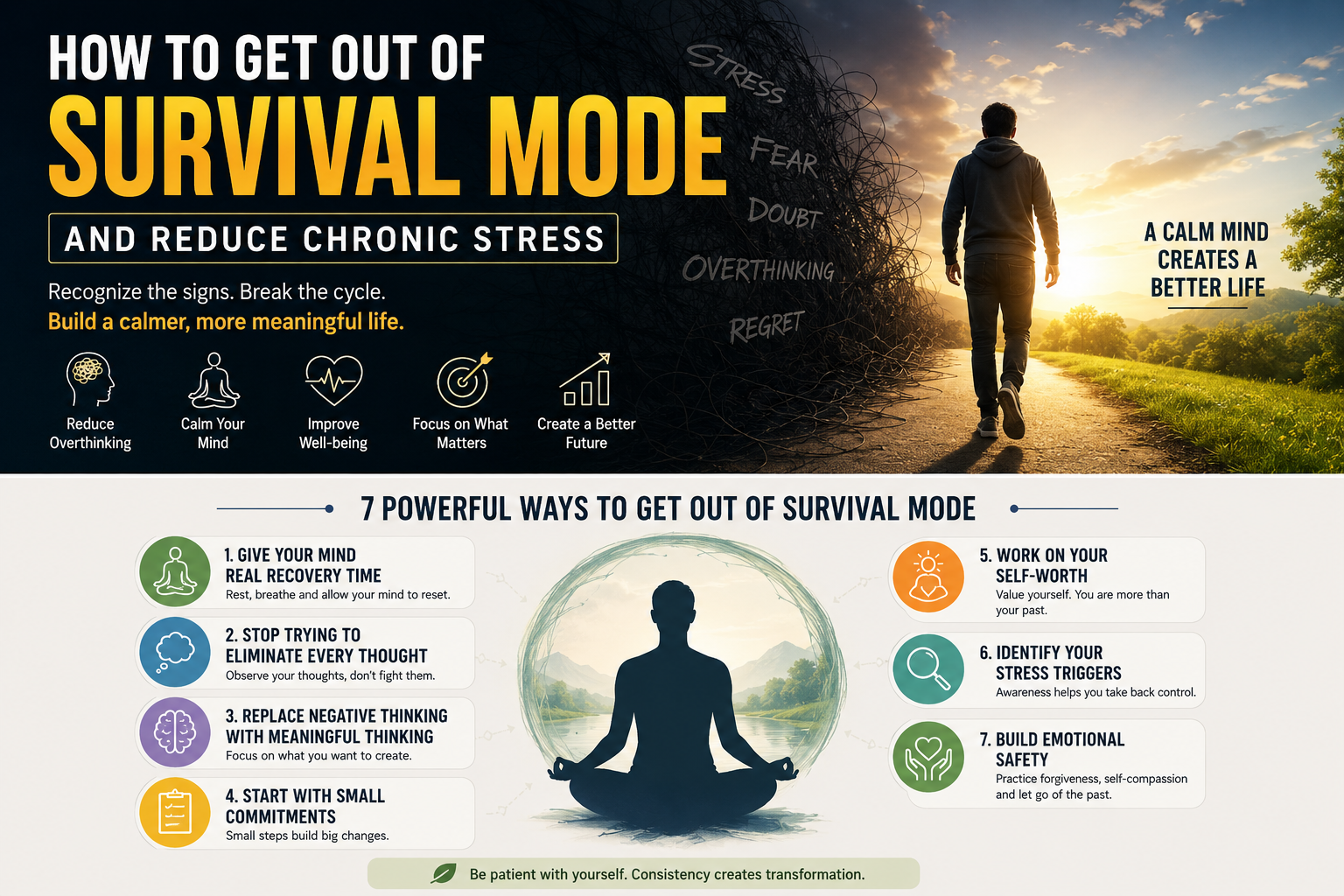
7 Practical Ways to Get Out of Survival Mode
Moving out of a chronic stress pattern usually isn’t about making one dramatic change.
Small, consistent changes can be more realistic.
1. Give Your Mind Real Recovery Time
One of the strongest messages from the transcript is the importance of recovery.
Modern life makes it easy to remain mentally stimulated all day:
- Work
- Notifications
- Social media
- Short videos
- News
- Emails
- Messages
- Constant multitasking
Even when your body is resting, your mind may still be working.
Create periods during the day when you deliberately reduce stimulation.
You could:
- Take a quiet walk
- Sit without your phone
- Practice slow breathing
- Stretch
- Take a short nap when appropriate
- Spend a few minutes in meditation
- Simply sit quietly and observe your surroundings
The goal is not to become productive every minute of the day.
Sometimes recovery itself is productive.
2. Stop Trying to Eliminate Every Thought
One of the biggest mistakes people make with overthinking is trying to completely stop thinking.
That is unrealistic.
The goal is not to have an empty mind.
Instead, learn to notice thoughts without automatically treating every thought as a fact.
For example:
Thought:
“I am going to fail.”
Instead of immediately accepting it, try:
“I am having a thought that I might fail.”
That small change creates some distance between you and the thought.
Mindfulness-based approaches similarly encourage observing thoughts and feelings without automatically reacting to them.
3. Replace Negative Thinking With Meaningful Thinking
Think of your mind as a garden.
If you constantly focus on unwanted thoughts, you may end up spending most of your attention on problems.
Instead of asking:
“How do I stop thinking negatively?”
try asking:
“What do I want to think about instead?”
For example, choose a few meaningful areas of life:
- Health
- Family
- Career
- Learning
- Financial stability
- Relationships
- Creativity
- Travel
- Personal growth
Then turn those values into realistic goals.
For example:
Instead of:
“I don’t want to be unhealthy.”
Try:
“I want to become physically stronger and have more energy.”
Instead of:
“I don’t want to fail financially.”
Try:
“I want to build better financial habits and increase my skills.”
The difference is subtle but important.
You are shifting your attention from avoiding something to building something.
4. Start With Small Commitments
If you have been procrastinating for a long time, don’t begin with an enormous goal.
Start extremely small.
For example:
- Read one page
- Walk for 10 minutes
- Clean one small area
- Write for five minutes
- Complete one pending task
- Spend 15 minutes learning a skill
Then finish what you started.
The purpose isn’t the size of the task.
The purpose is rebuilding the belief:
“I can start something and finish it.”
Once this becomes a repeated experience, larger tasks may feel less intimidating.
The NHS also recommends setting small, achievable targets rather than trying to do everything at once when dealing with anxiety.
5. Work on Your Self-Worth
Sometimes the problem isn’t the goal.
It is the way you see yourself while pursuing the goal.
If you constantly tell yourself:
- “I’m not good enough.”
- “Other people are better than me.”
- “I’ll probably fail.”
- “I don’t deserve success.”
then every new opportunity can become threatening.
Building self-worth doesn’t mean convincing yourself that you are perfect.
It means developing a more balanced view of yourself.
Recognize:
- What you have already learned
- Difficult situations you have handled
- Skills you have developed
- Mistakes you have survived
- Small improvements you have made
Your past failures are experiences—not your permanent identity.
6. Identify Your Stress Triggers
Pay attention to situations that consistently increase your stress.
Your triggers might include:
Work-related triggers
Deadlines, difficult managers, excessive workload or uncertainty about employment.
Financial triggers
Debt, unexpected expenses, unstable income or fear about the future.
Relationship triggers
Arguments, rejection, criticism or lack of emotional support.
Internal triggers
Negative self-talk, catastrophic thinking or memories of difficult experiences.
Digital triggers
Constant notifications, social media comparison, excessive news consumption and endless scrolling.
Once you identify a trigger, ask:
“Can I change this situation, change my response, or create some distance from it?”
You don’t need to solve everything immediately.
Awareness itself is progress.
7. Build Emotional Safety
Another important theme in the transcript is emotional safety.
When a person carries guilt, regret, resentment, loneliness or unresolved anger for a long time, these emotions can affect how they experience the present.
One way to work with these feelings is to practice forgiveness.
Forgiveness does not mean saying that harmful behavior was acceptable.
It means gradually reducing the emotional control that an old event or person has over your present life.
You can also practice compassion toward yourself.
Instead of:
“Why did I make such a stupid mistake?”
try:
“I made a mistake. What can I learn from it?”
This doesn’t erase the past.
It changes your relationship with it.
The Role of Mindfulness and Breathing
Breathing exercises and mindfulness can be useful tools for managing stress.
When you notice your mind racing, bring your attention back to your body.
Notice:
- Your breathing
- Your shoulders
- Your posture
- The sensations in your hands
- The sounds around you
- What you can see
- What you are doing right now
You don’t have to force yourself to stop thinking.
Simply observe what is happening.
Calming breathing exercises, meditation, regular exercise and talking to someone you trust are among the practical strategies recommended by the NHS for anxiety and stress.
Don’t Ignore Your Physical Health
Mental and physical well-being are closely connected, but it is important not to attribute every physical symptom to stress.
Regular physical activity, balanced meals, adequate sleep and hydration can support overall well-being.
Exercise can also be a useful part of managing anxiety and stress. The NHS recommends activities such as walking, running, swimming and yoga as potentially helpful ways to relax.
However, persistent or unexplained symptoms should be discussed with a healthcare professional rather than self-diagnosed as anxiety.
What About NLP, Visualization and Similar Techniques?
The original transcript discusses techniques such as NLP, visualization and other approaches to changing emotional patterns.
These techniques are sometimes promoted as tools for personal development. However, they should not be presented as guaranteed ways to erase traumatic memories, change hormones, cure anxiety or treat medical conditions.
If someone is dealing with significant anxiety, trauma or emotional distress, evidence-based psychological treatment and professional assessment are safer foundations.
For example, CBT is a well-studied psychotherapy commonly used for anxiety disorders, while other approaches may also be appropriate depending on the individual’s situation.
Create a Future You Actually Want
One of the most useful ideas in the original discussion is to shift attention from simply escaping problems toward building a meaningful future.
Take a few minutes and ask yourself:
What matters most to me?
Maybe your answer is:
- Good health
- Financial stability
- Family
- Meaningful relationships
- Career growth
- Freedom
- Learning
- Creativity
- Travel
- Personal growth
Now imagine what those values would look like in everyday life.
Don’t focus only on the final result.
Think about the habits that would create it.
If health matters, perhaps your goal is regular walking.
If learning matters, perhaps you read 10 pages every day.
If relationships matter, perhaps you make time for the people you care about.
If financial stability matters, perhaps you start tracking your expenses.
A meaningful future is built through repeated actions in the present.
You Don’t Have to Fix Everything at Once
Getting out of survival mode isn’t about becoming a completely different person overnight.
It can start with something much simpler:
One calm moment.
One completed task.
One healthy decision.
One honest conversation.
One better night’s sleep.
One small step toward something meaningful.
When these actions are repeated, they can gradually create a different daily pattern.
And that is often more realistic than waiting for one huge breakthrough.
When Should You Seek Professional Help?
Stress and occasional anxiety are normal parts of life.
But if anxiety or stress becomes persistent, difficult to control or starts interfering with work, relationships, sleep or everyday activities, professional help may be appropriate.
A mental health professional can help identify what is contributing to the problem and recommend an appropriate treatment approach. Anxiety disorders can be treated, and treatment may include psychotherapy, medication, or a combination depending on the individual’s circumstances.
If you are experiencing thoughts of self-harm or suicide, seek urgent professional help rather than trying to manage the situation alone.
Final Thoughts
Being in survival mode can feel like constantly running without actually getting anywhere.
You may be working hard, thinking constantly and trying to solve one problem after another, yet still feel stuck.
The answer isn’t necessarily to push yourself harder.
Sometimes the first step is to slow down enough to understand what is keeping you in a constant state of stress.
Look at your thoughts.
Identify your triggers.
Give yourself time to recover.
Break large goals into smaller actions.
Work on your self-worth.
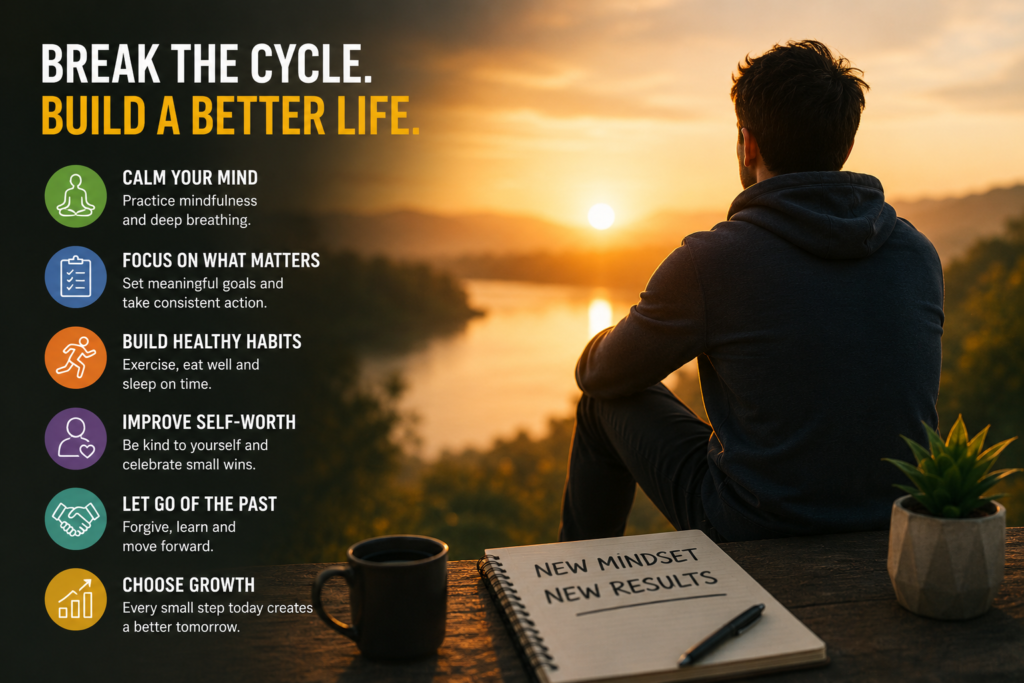
Build healthier routines.
And when the problem feels too difficult to handle alone, ask for professional support.
You don’t need to solve your entire future today.
Focus on the next healthy step.
Frequently Asked Questions
What is survival mode?
“Survival mode” is a commonly used term for a state in which a person’s attention and energy are heavily focused on immediate threats, stress and uncertainty. It is not a formal medical diagnosis.
What are the signs of being stuck in survival mode?
Common experiences can include constant worry, difficulty relaxing, overthinking, procrastination, decision-making difficulties, emotional exhaustion, sleep problems and feeling overwhelmed.
Can chronic stress affect decision-making?
Persistent stress can affect concentration, sleep, mood and the ability to think clearly. If decision-making problems are severe or persistent, professional evaluation may be helpful.
How can I get out of survival mode?
Start with manageable changes such as improving sleep, taking recovery breaks, exercising, practicing mindfulness, identifying stress triggers, completing small goals and seeking professional support when necessary.
Can mindfulness help with anxiety?
Mindfulness and related techniques can help people become more aware of their thoughts, feelings and physical sensations. They may be useful as part of a broader approach to managing anxiety.
When should I see a mental health professional?
Consider professional help when anxiety or stress becomes persistent, difficult to manage or begins affecting your work, relationships, sleep or everyday life.
National Institute of Mental Health — Anxiety DisordersNIMH: Anxiety DisordersNHS — Anxiety, Fear and PanicNHS: Anxiety, Fear and PanicNHS — Self-help CBT techniquesNHS: Self-help CBT techniques