
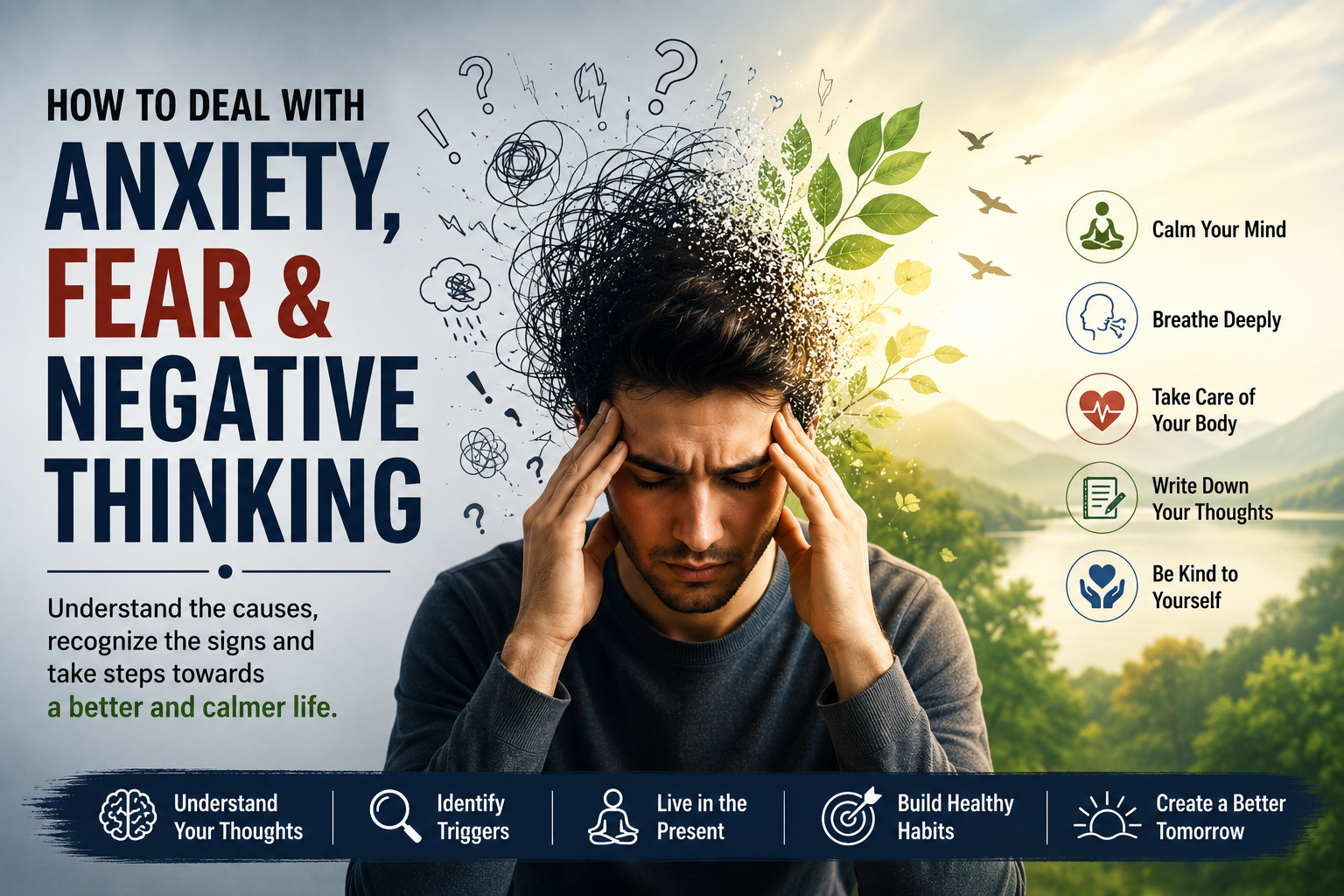
If you’ve ever lain awake at 2 a.m. with your heart pounding for no clear reason, or felt a wave of dread wash over you even though nothing “bad” has actually happened, you may already be familiar with anxiety. An entire generation is quietly struggling with fear, anxiety, and negative thinking and the strange part is that you don’t need to be sick, you don’t need to have suffered a major loss, and you don’t need a dramatic tragedy in your life for this to happen to you.
Many people carry a nagging feeling that life isn’t going well, that they don’t want to keep going, or that something is simply “off” inside them — even when, on paper, everything looks fine. This article breaks down why this happens, what’s really going on inside your body and mind, and what you can actually do about it.
Anxiety Is Not Just “In Your Head” It’s In Your Body Too
Anxiety rarely shows up as thoughts alone. It shows up physically. A racing heartbeat. Sleeplessness. A tight, congested feeling in the chest, almost like your chest is closing up. A throat that feels blocked. A breathing passage that feels tighter than usual. For many people, this discomfort isn’t limited to the chest — it settles right below the ribs, in the gut, which functions almost like a second brain because of how closely it’s wired to the nervous system.
Alongside the physical discomfort comes a particular flavor of negative thinking. It isn’t just stray gloomy thoughts — it’s the feeling that “my life is over,” that nothing excites you anymore, that you’re going through the motions at work or in relationships like an emotional zombie, feeling nothing at all.
So the real question is: why won’t the mind just stop?
Anxiety and the Survival Mode
Here’s something worth sitting with, negative thinking is not actually the root problem. It’s a symptom. The real issue is that your mind has slipped into what’s called survival mode.
There are two broad operating modes for your nervous system:
- Survival Mode (Sympathetic Nervous System / SNS): This is your body’s alarm system. Think of it as an internal earthquake. When it’s active, you cannot relax, you cannot be creative, and you cannot enjoy anything — all your energy is focused on one question: how do I get out of danger?
- Creative Mode (Parasympathetic Nervous System / PNS): This is the calm, restorative state. When the “earthquake” settles, your organs return to their natural rhythm, and you experience what’s called homeostasis — a state where your body and mind feel like everything is, genuinely, okay.
If your survival mode is switched on constantly, you will never experience homeostasis — no matter how hard you try to “think positive.”
Your Mind’s Real Job Isn’t to Make You Happy
This is worth writing down: the primary job of your mind is not to make you happy — it’s to keep you alive.
When anxiety symptoms show up a racing heart, sweating, trembling, a mind that won’t switch off these aren’t signs that something is broken. They are signs that your mind and body are trying, in their own clumsy way, to protect you. Your body has learned certain patterns and perceptions over time, and right now, it genuinely believes it needs to prioritize survival over everything else.
Watch any wild animal a deer or a zebra being chased by a predator. The moment the chase is over and it has escaped, its body physically shakes to release the stress hormones and reset itself. Then it goes back to grazing peacefully. Humans, unfortunately, rarely complete this cycle. We get triggered, but we rarely “shake it off” so the stress response lingers, sometimes for years.
Why Anxiety Keeps Creating “What If” Scenarios
Negative thinking usually sounds like an endless loop of “what if”:
What if I fail? What if I lose my job? What if I can’t repay this loan? What if, what if, what if…
The brain’s alarm center — the hypothalamus — cannot always tell the difference between an imagined threat and a real one. When these “what if” images become vivid and repetitive enough, the hypothalamus treats them as real danger and pushes your body deeper into survival mode. This, in turn, generates more negative thinking, which increases anxiety further. Sleep disappears. Digestion suffers — constipation or loose motions. Even the sleep you do get is filled with disturbing dreams. And somewhere in the middle of all this, you find yourself asking, “What’s even the point of any of this?”
Hidden Causes of Anxiety You May Not Be Aware Of
People often try to logic their way out of anxiety: I have a good job, I have money, I have a partner, I have a car — so why am I not happy? Relatives often say the same thing: “You have everything, why are you so anxious?”
But logic doesn’t work here, because anxiety usually lives in the deep subconscious, not the logical, conscious part of the brain. The subconscious is what actually controls your organs, your body temperature, your fluid balance not your rational arguments.
Some common hidden roots of chronic anxiety include:
- Childhood memories a broken dream, harsh criticism, rejection, feeling unworthy, or witnessing something painful.
- A past trauma, physical or emotional, that was never properly processed.
- A significant rejection or failure that left a lasting imprint.
- Grief or loss someone leaving your life, whether through death or estrangement.
- Humiliation experienced at some point.
- A dark or uncertain view of your own future that has crept in over time.
- Living around a difficult or manipulative person who keeps creating chaos in your life.
Here’s the tricky part: your subconscious mind constantly looks for similarity. If you read a news story or watch a show that echoes an old, unresolved memory even one you consciously “forgot” your subconscious can instantly pull you back into that old pain, often with more intensity than you originally felt it, because as an adult you now understand how serious the original event actually was.
A painful memory that hasn’t been processed is like a thorn that keeps releasing a low dose of poison into your system, sometimes for years or decades, regardless of how much time has passed on the calendar.
What’s Actually Happening Chemically
When an old pattern gets triggered, the hypothalamus interprets it as a threat and immediately signals the release of cortisol (produced in the adrenal glands). Cortisol pushes your body into fight-or-flight — useful if you’re facing an actual predator, far less useful if you’re facing a stressful email.
The catch: as cortisol rises, your feel-good chemicals — dopamine, oxytocin, serotonin, endorphins, melatonin (your sleep hormone), and GABA (your calming hormone) — all drop toward zero. So you end up with high stress hormones and almost no calming hormones at the same time, which is precisely why anxiety feels so physically unbearable.
In the modern world, we rarely face literal predators — but we do face an unlimited, constant stream of anxious thoughts, and the body reacts to imagined threats almost the same way it would to a real one.
Signs That Anxiety Is Taking Control of Your Life
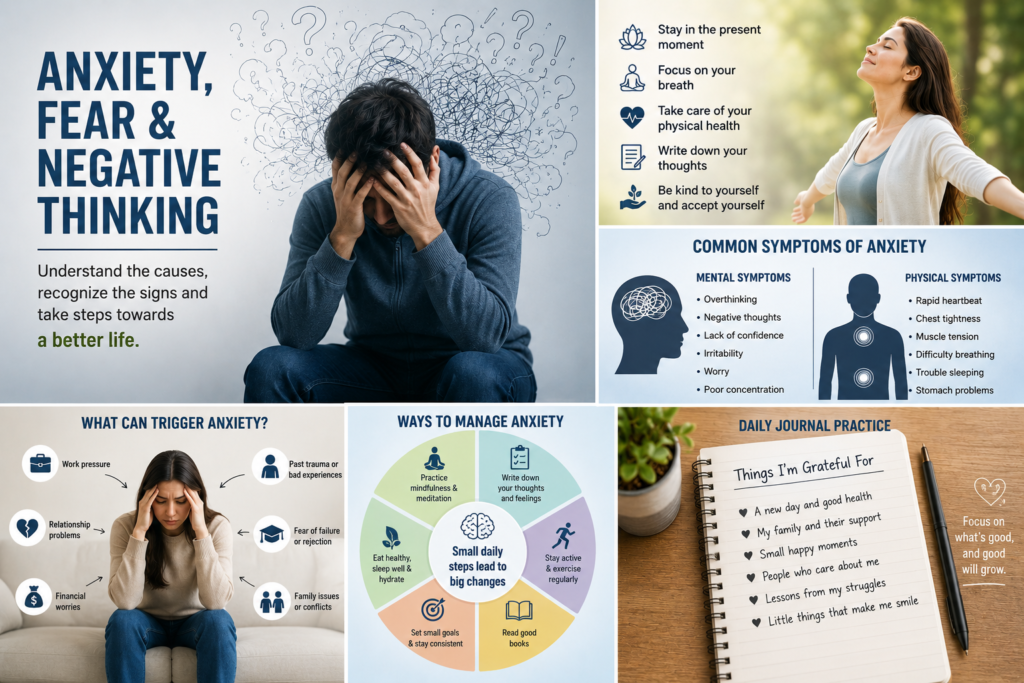
It helps to recognize the pattern clearly rather than dismiss it. Common signs include:
- Constant overthinking — thoughts about money, the future, or “what if” scenarios that simply won’t stop.
- Loss of concentration — an inability to read, study, or focus on work.
- Imagining worst-case scenarios — sometimes escalating into dark or even suicidal thoughts.
- Constant self-doubt.
- Mental exhaustion — feeling drained even without physical exertion.
- Emotional numbness — no longer feeling anything toward relationships, career, money, or the future.
Physical symptoms often include a racing heartbeat, a tight chest, excessive sweating, trembling, poor sleep, digestive issues, and muscle tension. If several of these sound familiar, it’s worth taking seriously and speaking to a qualified doctor or mental health professional rather than trying to push through alone.
Why “Just Think Positive” Doesn’t Work
A lot of people try to repeat affirmations — I am confident, I am okay, I am calm, I am happy while an internal earthquake is still raging underneath. This is sometimes called a “defensive operation”: you’re outwardly performing calm while inwardly nothing has actually shifted.
That’s because affirmations operate at the conscious level, using willpower, while the anxiety itself lives at the subconscious level. Trying to fix a subconscious problem with conscious-level statements is a bit like searching for your lost wallet in the wrong city no matter how thoroughly you search, you won’t find it, because you’re looking in the wrong place.
What Actually Helps
None of this means you’re stuck. Anxiety is treatable, and there are concrete, evidence-informed steps that genuinely help calm the nervous system over time.
1. Slow, Deep Breathing
When anxiety hits, breathing becomes shallow, leading to a drop in oxygen levels (a state called hypoxia), which keeps the body locked in fight-or-flight. Deliberate, slow, deep breathing restores oxygen supply and signals the body that it’s safe to calm down. This is part of why people who practice regular breathing exercises tend to look visibly more relaxed over time.
Note: If you are in the middle of an acute anxiety or panic episode, please reach out to a doctor, therapist, or emergency medical service — professional support is essential for emergencies.
2. Stop Believing Every Thought
Not every anxious thought deserves your belief. When a catastrophic thought shows up — “I’ll never be okay,” “everything is falling apart” — pause and ask: Is there actual evidence for this? Often, there isn’t. Some people find it helpful to gently defuse an intrusive thought by labelling it as just “noise” rather than fact, which reduces its emotional grip.
3. Practice Mindfulness — Stay in the Present
Instead of spiraling into “what will happen tomorrow,” bring your attention to right now: How am I breathing? How does my body feel right now? What is my mind actually doing in this moment? Simply observing these things, without judgment, tends to naturally slow down racing thoughts and calm the body.
4. Take Care of Your Body
- Eat well — favor whole, balanced foods over processed or junk food.
- Stay hydrated — proper hydration helps your cells function calmly. Adding a small amount of mineral-rich salt to your water can help replace minerals that anxiety tends to deplete.
- Move your body — yoga, stretching, exercise, and even regular massage all increase oxygen supply and help minimize anxiety.
5. Address the Past
If old, unresolved memories or trauma are feeding your anxiety, consider working with a qualified therapist or counselor who specializes in trauma processing. Unprocessed pain rarely resolves on its own — professional support can make a significant difference.
6. Build a Stronger Self-Image
As Einstein reportedly noted, a problem cannot be solved from the same perspective that created it. If a poor self-image is feeding your anxiety, working — ideally with professional guidance — to build a healthier, more grounded self-image is essential.
7. Identify and Manage Your Triggers
Notice the specific people, situations, or environments that consistently spike your anxiety — a certain relationship dynamic, a work situation, a recurring conflict. Naming these triggers is the first step toward managing your response to them.
8. Visualize a Brighter Future
Anxiety often erodes our sense of hope about the future. Deliberately spending a few minutes imagining a positive, hopeful future — not as wishful thinking, but as a way of retraining your nervous system to expect safety rather than danger — can help rebuild that sense of hope over time.
9. Keep a “Treasure” Journal
One of the quiet effects of anxiety is that it erodes your memory bank of happiness. A simple but powerful exercise: write down fifty small, specific happy memories from your life — the day you got a new pair of shoes as a child, a small win at school, a fun moment with a friend. They don’t need to be grand. When anxiety flares up, reading through this list can help reconnect you with a felt sense of joy and hope that anxiety tends to numb out.
A Gentle Reminder
Anxiety can feel overwhelming, isolating, and even frightening in the moment — but it is not a life sentence. Understanding why your mind and body are reacting this way is often the first real step toward calming them down. Be patient with yourself, avoid judging yourself for feeling this way, and don’t hesitate to lean on people you trust and on qualified professionals — doctors, therapists, and counselors — who can guide you through the deeper layers of this work.
NIMH (National Institute of Mental Health)
Anchor text: anxiety disorders
Link: NIMH – Anxiety DisordersNHS
Anchor text: anxiety and panic attacks
Link: NHS – Anxiety and Panic Attacks
This article is for general informational purposes and is not a substitute for professional medical or psychological advice. If you are experiencing persistent anxiety, overwhelming distress, or thoughts of self-harm, please reach out to a licensed mental health professional or a local crisis helpline in your area you don’t have to go through this alone.